Project Credible has recently made available a new publication capturing the outcomes of the European Carbon Farming Summit (ECFS) 2026, which was held in Padua from 17–19 March 2026 and gathered more than 700 participants including policymakers, researchers, farmers, businesses, certification bodies, and civil society representatives from across Europe. The document contains a detailed description of all plenary and parallel sessions, as well as the concrete recommendations that emerged from workshops and discussions.
After the event, MARVIC coordinator Greet Ruysschaert highlighted that discussions are now converging, but challenges still remain, for example in data sharing between the public and private sector. Another key aspect to address is ensuring that innovative regenerative farmers that have large diversity in crops and crop mixtures can access the carbon farming markets, not being limited by this complexity and the inability of models to capture it.
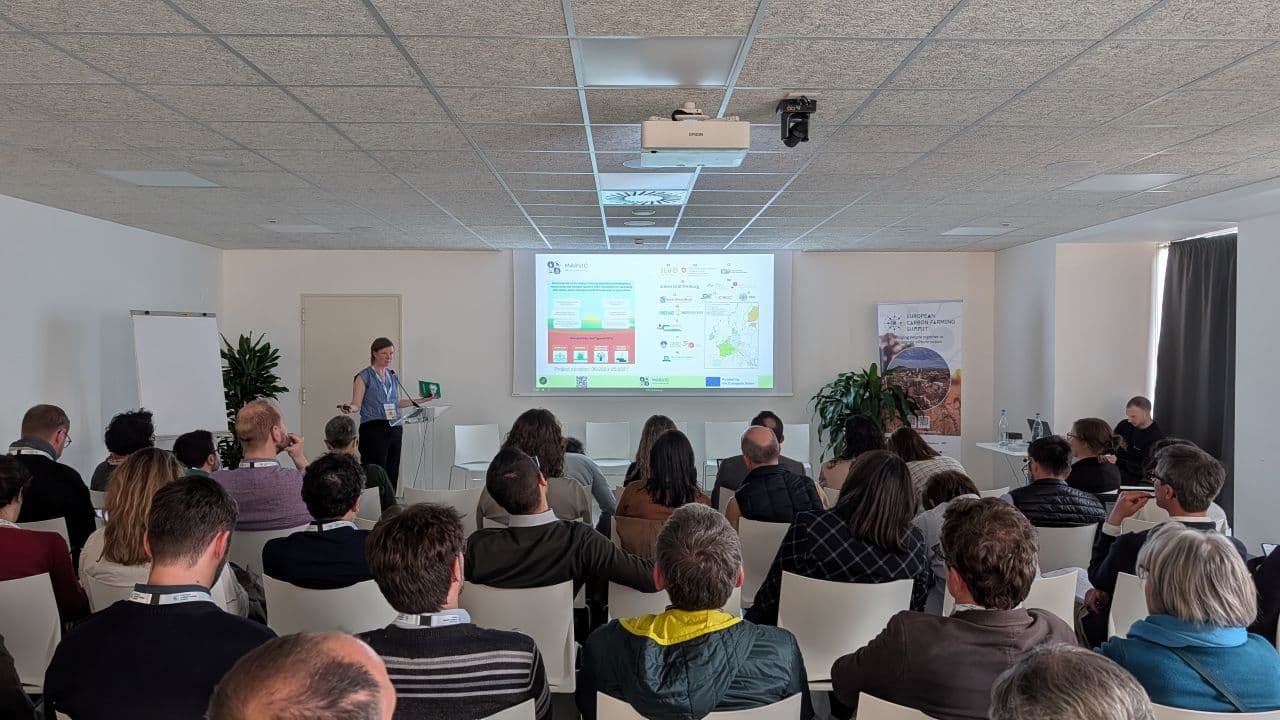
Among the almost 50 sessions that shaped the ECFS26, MARVIC had direct participation in eight, co-organising two of them. Ruysschaert was precisely one of the organisers of a session on soil carbon modelling for scalable and reliable Monitoring, Reporting and Verification (MRV), where insights from MRV4SOC and MARVIC Projects were shared with more than 40 participants. In this session, both projects presented and compared results of different soil models’ performance, with and without remote sensing data assimilation. Moreover, dedicated presentations showcased outcomes from the implementation of MRV frameworks in agroecosystems under different management practices at both local and regional scales.
Throughout the presentations and discussions, some general areas of consensus were identified. For example, it was highlighted that hybrid MRV approaches can provide an effective and cost-efficient way to quantify soil carbon removals. These approaches reduce the need for extensive soil sampling while ensuring that methods are adapted to the site’s specific pedoclimatic and agricultural conditions, in line with the Carbon Removals and Carbon Farming (CRCF) rules.
Furthermore, a series of specific recommendations were provided, targeting mainly researchers and MRV providers. From the modelling side, it was underscored that robust, transparent, and cost-effective models require high-quality key input data. The importance of having specific guidelines for model initialisation and uncertainty quantification, as well as the establishment of a network of well-monitored benchmark sites, was also pointed out. The session also explored particularities referring to MRV systems in croplands in arid Mediterranean ecosystems, among many other insights from both projects.
Find the full content of the presentations and discussions of this session (and all others) in Credible’s Overview of sessions, contributions, and recommendations , or revisit the session here.